Your supervisor returns your draft with two comments: the argument needs more evidence, and the writing feels stiff. Those are different problems. More polished sentences cannot repair a weak study. But once the research is sound, careful editing can help readers see what you did, why it matters, and what the findings actually support.
Here, “sounds like AI” means vague claims, repeated summaries, and formulaic prose. These features do not establish who wrote a paper. The goal is clearer academic writing, with each sentence doing a useful job.
This guide organizes 15 prompts into seven revision stages, from the first complete draft to the final submission check. Use them in GPT-6, one stage at a time, or with another model that can follow the editing constraints. These are editorial templates, not a model benchmark or a promise of publication or detector results.

AI-generated editorial illustration. It depicts revision, not measured research results.
Start with boundaries, not a request to “humanize” everything
Save the original draft. Work through one stage, review the proposed changes, and only then move on. For a long paper, edit by section and supply the research question, a terminology list, and enough context to understand the argument.
Paste this shared instruction before the prompt for each stage:
You are an academic editor. Address only the writing issue I specify in this round.
Do not change the research claims, data, methods, results, conclusions, or citation attribution.
Preserve negation, conditions, scope, and uncertainty. “May” must not become “demonstrates.”
Do not add data, references, examples, mechanisms, or limitations I have not supplied.
If evidence is missing, write “Author input needed.” Do not guess.
Leave clear sentences unchanged. Maintain the formal style appropriate to the discipline.
For each proposed change, return:
Original sentence | Suggested revision | Reason | Items for the author to verify.
Then provide the revised passage.

Research question: [fill in]
Scope of this editing round: [section or paragraphs]
Confirmed terminology and facts: [fill in]
Manuscript: [paste here]
All before-and-after passages below are hypothetical teaching examples, not descriptions of actual studies. Bracketed text marks information the author must verify and supply. Remove every placeholder before submission.
The seven-stage revision workflow
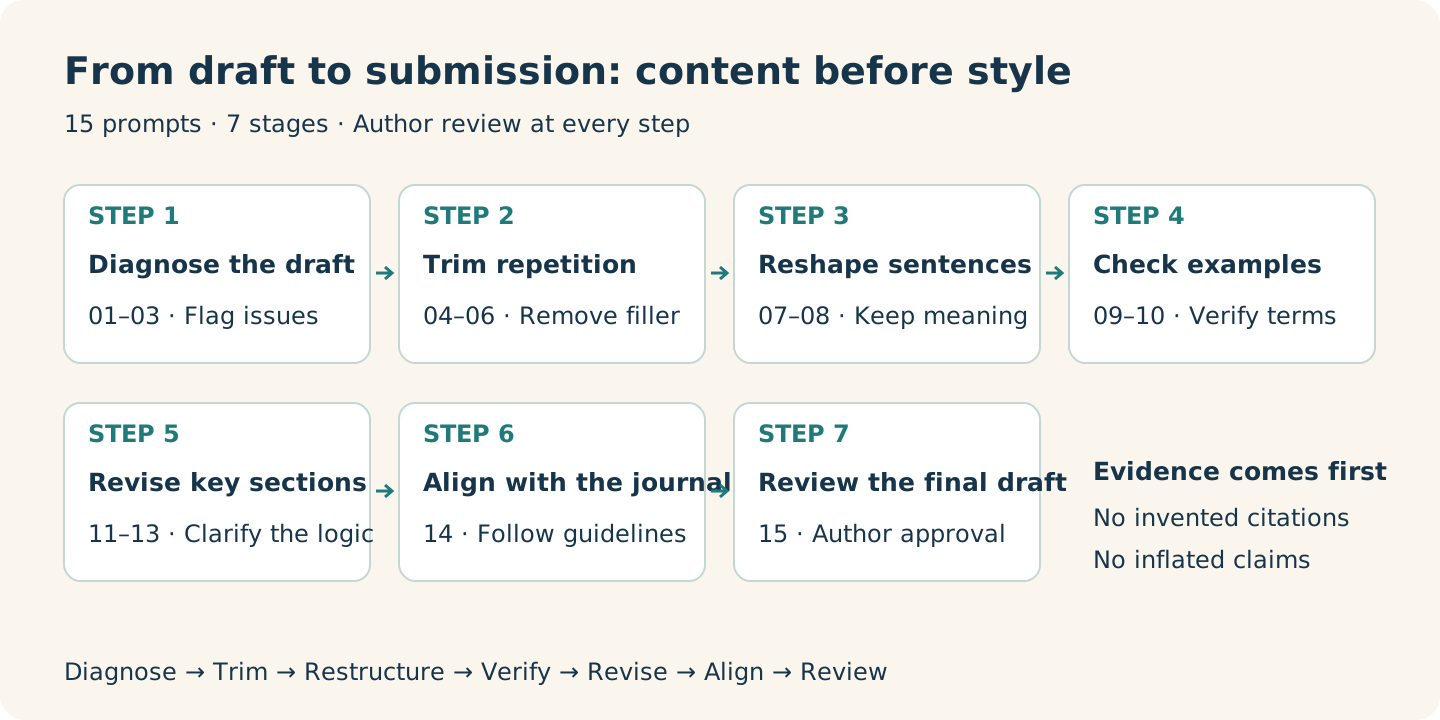
Settle the content and argument before adjusting style. Return to an earlier stage if new evidence changes the paper.
| Stage | Prompts | When to use it | What to keep from the round |
|---|---|---|---|
| 1. Diagnose the draft | 01–03 | You have a complete first draft | A list of writing problems and proposed edits |
| 2. Trim repetition | 04–06 | You have separated evidence gaps from wording problems | A shorter draft and a list of unresolved gaps |
| 3. Restructure sentences | 07–08 | You have checked that the content is intact | Clear subjects and readable sentences |
| 4. Check examples and terms | 09–10 | The structure is mostly stable | Verified examples and a terminology list |
| 5. Revise openings and endings | 11–13 | The core argument is settled | A focused introduction, conclusion, and transitions |
| 6. Align with the journal | 14 | You have chosen a target journal | Small adjustments grounded in its guidelines |
| 7. Review the final draft | 15 | You are preparing to submit | A draft whose claims you can explain and defend |
Stage 1: Diagnose before rewriting
Before editing sentence by sentence, read the draft for repeated phrases, empty transitions, and claims that sound substantial but say little. Diagnosis and revision can be separate rounds. This gives you a chance to catch places where the model treats a research problem as a wording problem.
01 · Find formulaic academic prose
Use when: You need an overview of repetitive or vague writing in a complete draft.
Read the manuscript paragraph by paragraph as an experienced academic editor.
Flag:
1. Repeated stock phrases;
2. Sentences that repeat information to create a neat or balanced structure;
3. Summaries or transitions that add no useful information;
4. Academic-sounding language that does not identify a specific claim.

Explain what each flagged passage fails to communicate before suggesting an edit.
Change expression only. Preserve the data, methods, results, conclusions, and argument order.
Mark every change. Keep parallel structures and summaries that serve a real purpose.
Do not make the writing conversational merely to make it sound less like AI.
Before:
The digital economy has become a major engine of growth, with profound theoretical and practical significance. This study uses platform sellers’ business records from 2018 to 2023 to examine the relationship between commission changes and seller exit. Its findings will have far-reaching implications.
After:
This study uses platform sellers’ business records from 2018 to 2023 to examine the relationship between commission changes and seller exit.
The revision retains the subject, period, and question. It removes unsupported claims of importance. A stronger opening may need background evidence or a literature gap, but the author must supply that material. Editing cannot invent market shares or industry trends.
02 · Break up mechanical parallel structures
Use when: The draft repeatedly promises “a theoretical breakthrough, a methodological innovation, and a practical contribution” without explaining any of them.
Find lists of three or more claims, repeated sentence structures, and recurring
patterns such as “not only X, but also Y” or “both X and Y.”
Check whether each part adds distinct information.
Keep informative parallel structures. For vague or repetitive passages, reorganize
only the supplied material into a fact, supporting evidence, and a supported implication.
Mark missing evidence as “Author input needed.” Do not fill it in yourself.
Avoid repeated sentence patterns without forcing every list into a different form.
Before:
The model represents a theoretical breakthrough, a methodological innovation, and a guide for practice.
What to do: Ask what assumption changed, what method is new, and what application the findings support. The sentence alone cannot answer those questions. Do not turn “methodological innovation” into a claim that the study replaced ordinary least squares with instrumental variables unless the manuscript actually says so.
Each part needs a different informational role. Replacing three grand phrases with three different grand phrases changes little.
03 · Check stock transitions
Use when: “First,” “second,” “finally,” and “it is worth noting” appear frequently, but the relationships between ideas remain unclear.
Locate stock transitions such as “first,” “second,” “finally,” “in summary,”
“it is worth noting,” “clearly,” and similar phrases.
For each one, check whether removing it preserves sequence, cause, contrast, or progression.
If the relationship remains clear, remove it.
If it expresses a necessary relationship, keep it.
If removal exposes a missing connection, revise the next sentence using the supplied
argument, or ask the author to clarify the relationship.
Do not delete all transitions or replace them with different stock phrases.
Before:
First, we review the literature. Second, we develop hypotheses. Finally, we test them using survey data.
After:
We review the literature, develop hypotheses, and test them using survey data.
If the manuscript explains how a particular disagreement led to a hypothesis, state that relationship. If it does not, flag the gap. Use search to locate transitions, then review each occurrence; do not bulk-delete words that communicate experimental sequence or reasoning.
Stage 2: Trim what the paper does not need
Before deleting a sentence, ask whether it adds information, explains something difficult, limits a claim, or connects the argument. Concision should preserve those functions.
04 · Remove empty paragraph endings
Use when: A paragraph ends by repeating what it has already established.
Review the last sentence of every paragraph.
Recommend removing sentences that only restate the preceding material without a useful purpose.
Keep endings that add an inference, a limitation, a change of perspective,
a new interpretation, or a necessary summary of complex reasoning.
Explain each deletion. Do not invent findings or limitations to give paragraphs a neat ending.
Before:
Overall, the rigorous experimental design and appropriate variable selection provide a useful reference for future research.
What to do: Remove it if the paragraph already explains the design and variables. If a limitation matters here, draw it from the actual methods or discussion. Do not create a sample restriction simply to make the ending more specific.
05 · Replace vague claims of importance
Use when: Phrases such as “widely discussed,” “increasingly important,” or “profound impact” take the place of evidence.
Find vague claims of importance, scale, attention, or impact.
Delete modifiers that do not change the factual meaning.
When the judgment matters to the argument, express it using only the supplied data,
literature, observations, population, or time range.
If support is missing, flag an evidence gap.
Do not substitute another vague adjective or invent publication counts.
Before:
This issue has attracted widespread attention and has become a major research focus.
What to do: Delete the sentence if that claim does no work. If the paper needs to describe the state of research, provide the search scope, sources, and relevant lines of inquiry. The model cannot turn the sentence into “14 of 23 studies examined this issue” without a verified review behind it.
06 · Replace intensifiers with existing results
Use when: Words such as “greatly,” “effectively,” or “substantially” stand in for the size of an effect.
Check intensifiers such as “very,” “greatly,” “effectively,” “clearly,”
“substantially,” and “significantly.”
Remove them only when doing so preserves meaning and certainty.
When magnitude matters, use the quantitative results already supplied.
Preserve the metric, evaluation dataset, baseline, units, and uncertainty information.
Keep “significant” when it has a supported statistical meaning.
If a value is missing, flag it. Do not invent an improvement.
Before, with results already supplied:
The strategy effectively improved predictive performance, increasing the test-set F1 score from 0.71 to 0.86.
After:
With this strategy, the model’s test-set F1 score increased from 0.71 to 0.86.
This reports a numerical difference; it does not establish statistical significance. If uncertainty matters, use the actual intervals, repeated experiments, or appropriate test results from the study.
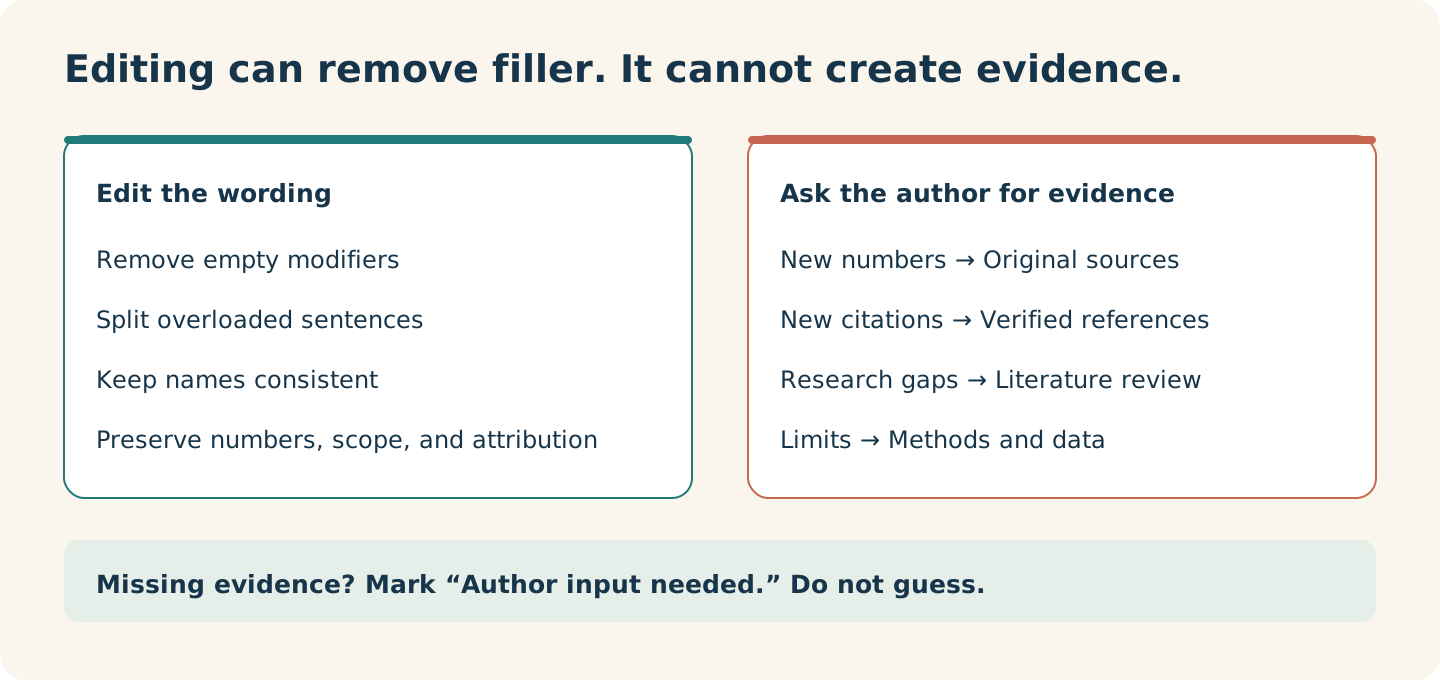
Evidence gaps need research material. Editing can organize the information you already have.
Stage 3: Make sentences easier to follow
Varying sentence length is useful only when it helps readers identify the subject, action, and relationship between ideas. There is no word-count formula for a good academic sentence.
07 · Choose active or passive voice deliberately
Use when: Repeated passive constructions obscure who conducted a study or reported a finding.
Review passive constructions, especially repeated “was considered,” “was used,”
“was demonstrated,” and “was found.”
Use active voice when the actor is known and naming it improves clarity.
Use only actors identified in the manuscript. Do not assign an unattributed claim to researchers.
Keep passive voice when the procedure, object, or recipient deserves the emphasis.
Preserve citation attribution and uncertainty.
Do not turn “is thought to be associated with” into “research proves.”
Before:
The indicator was used by the research team in a clinical prediction model, and its performance was evaluated by the team on an independent test set.
After:
The research team used the indicator in a clinical prediction model and evaluated its performance on an independent test set.
The passage does not report the outcome. The revision must not add that the indicator was effective or validated by multiple studies.
08 · Split overloaded sentences and connect fragmented ones
Use when: One sentence contains the theory, dataset, method, question, and purpose, or a paragraph reads like a disconnected checklist.
Identify sequences of overloaded sentences, disconnected short sentences,
and single sentences performing several different jobs.
Treat sentence length as a clue, not a mandatory threshold.
Split dense sentences where the reader must hold too many conditions at once.
Combine short sentences when their logical relationship is clear.
Preserve all research information, including the theory, period, population,
method, purpose, and qualifications. Do not add repetition to create rhythm.
Before:
Drawing on resource dependence theory and institutional isomorphism, this study uses procurement records from three tertiary hospitals in eastern coastal China for 2021–2023 and a two-way fixed-effects model to examine differences in departments’ use of high-value consumables following diagnosis-related group payment reform, with the aim of informing hospital management.
After:
This study uses procurement records from three tertiary hospitals in eastern coastal China for 2021–2023 to examine differences in departments’ use of high-value consumables following diagnosis-related group payment reform. The analysis draws on resource dependence theory and institutional isomorphism and uses a two-way fixed-effects model. It aims to inform hospital management.
The same information remains, but the reader can process it in smaller steps. Splitting the sentence does not establish the study’s causal validity; that depends on the research design.
Stage 4: Check examples and terminology
Examples should support or explain the argument. Terminology should let readers track the same concept throughout the paper. Check accuracy before polishing either.
09 · Remove examples that do no useful work
Use when: General anecdotes or familiar scientific stories have little connection to the actual research.
Locate examples introduced by “for example,” “for instance,” “such as,” and similar phrases.
Identify each example’s function: evidence, mechanism, counterexample, or explanation.
Recommend removing examples that have no useful role or do not fit the research question.
Keep necessary examples and check their source, scope, and connection to the argument.
Use replacements only from verified material supplied by the author.
Do not invent authors, dates, sample percentages, or references.
If a replacement is needed but unavailable, specify what the author should provide.
Before:
Research requires rigor, as illustrated by famous stories of scientists discovering laws through everyday observations.
What to do: In a paragraph explaining data cleaning, this anecdote does not clarify the cleaning rule. Remove it. If a concrete example is needed, use an actual procedure and source. Do not add a fabricated study reporting that it removed 9.4% of observations.
An example need not be essential to the proof to be useful. A well-chosen explanation can make an abstract method understandable.
10 · Keep concepts and names consistent
Use when: The same variable, population, or method appears under several names, making readers wonder whether the meaning has changed.
Check terms, variable names, abbreviations, and references throughout the manuscript.
Look for potentially inconsistent uses of “participants,” “respondents,” and “subjects”;
“model,” “framework,” and “pathway”; “sample” and “dataset”; and variant variable names.
Determine whether the expressions actually refer to the same concept before standardizing.
Keep distinctions that matter. Preserve references to other authors’ studies.
Return a terminology table:
Current wording | Referent | Recommended wording | Distinction for the author to confirm.
Then revise using that table, preserving initial definitions and necessary abbreviations.
If “respondents” and “participants” both refer to the same survey population, choose the term that fits the discipline and use it consistently. If one term includes people who did not complete the survey, keep the distinction and explain it.
Similarly, “our study” and “the study” are not interchangeable when the latter refers to someone else’s work. Consistent concepts matter more than repeating the same subject in every sentence.
Stage 5: Rework the introduction, conclusion, and transitions
The purpose here is to make the research question, findings, and boundaries easier to find. It is not an invitation to invent a stronger contribution.
11 · Give the introduction a specific opening
Use when: Several broad background sentences pass before the reader learns what the paper studies.
Review the introduction’s opening paragraph for generic starts such as
“with the rapid development of,” “in recent years,” or “has attracted increasing attention.”
When they add no necessary information, start with the research subject, phenomenon, or question.
Aim to identify the specific subject within the first three sentences.
Use verified facts already supplied; do not create numbers for a stronger hook.
Preserve the research question and do not state an unverified literature gap as fact.
Keep policy, theoretical, or historical background needed to understand the problem.
Before:
Against the backdrop of rural revitalization, labor outmigration has become an increasingly important issue with major practical implications. This study examines labor outmigration and public goods provision in six villages in Xiangxi, China.
After:
This study examines the relationship between labor outmigration and public goods provision in six villages in Xiangxi, China.
To open with demographic change instead, the author must provide the relevant statistics and sources. A useful introduction can move from an observation to evidence, existing explanations, and the study’s question. It cannot obtain those missing parts from stylistic editing alone.
12 · End with findings and real boundaries
Use when: The conclusion closes with “promising applications,” “new vitality,” or “a valuable reference for future work” without specifics.
Revise the conclusion’s final paragraph.
Remove vague forecasts that do not communicate a specific, supported point.
Prioritize the work actually completed, the central findings, and established limitations.
Draw all three from the manuscript.
Preserve the findings’ scope and uncertainty. Do not invent limitations, applications,
or future plans. Keep concrete future directions when they address a documented limitation.
List missing information for the author to supply.
Before:
This research has achieved meaningful results and will bring new vitality to the field, with promising application prospects.
What to do: Extract the actual finding from the results and the real boundary from the methods or discussion. The sentence itself does not contain enough material for a credible conclusion.
A structure you can fill in is:
Using [confirmed data and methods], this study examined [research question]. The results indicate [supported finding]. Because [documented limitation], the conclusion applies to [established scope].
Every bracket needs author-verified content.
13 · Make paragraph transitions express a relationship
Use when: Paragraphs connect through “furthermore,” “additionally,” or “moreover,” but the argument does not explain why the next point follows.
Check adjacent paragraphs, especially those linked by “furthermore,” “additionally,”
“meanwhile,” or “moreover.”
Identify the actual relationship: addition, contrast, explanation, robustness check,
or qualification of scope.
Keep useful transitions when the relationship is already clear.
Otherwise, revise the next paragraph’s opening to connect directly to the preceding point.
State only relationships supported by the manuscript. Flag uncertain connections.
Do not merely replace one connector with another or invent a test outcome.
Before:
The results support H1. Additionally, we assess robustness using alternative sample periods.
After:
The results support H1. To assess whether they depend on the sample period, we repeat the analysis using alternative periods.
The original does not report the robustness result. The revision therefore cannot claim that coefficient signs or statistical significance remained unchanged.
Stage 6: Align with the target journal
Once the argument is stable, read the journal’s author instructions and examine recent papers of a similar type in your field. A few paragraphs can reveal local writing habits; they do not establish all of the journal’s requirements.
14 · Calibrate style using guidelines and samples
Use when: You have chosen a journal and settled the manuscript’s content.
Here are the target journal’s relevant author instructions and writing samples:
[Paste the guidelines and two or three paragraphs you are entitled to use.
Identify the sources and article types.]

Analyze sentence density, length, word choice, data presentation,
argument pacing, and paragraph transitions.
Distinguish explicit requirements from habits observed in the samples.
State the limits of the sample before proposing small changes to my manuscript.
Borrow general stylistic features, not distinctive wording.
Preserve claims, data, conclusions, and citations. Do not add missing information.
When the samples conflict with the author instructions, follow the instructions.
List uncertain requirements for the author to check.
Focus on how the journal presents questions and evidence. Also check its actual rules for titles, abstract length, figures, references, and disclosure of AI assistance. A style sample cannot substitute for those instructions.
Stage 7: Read the paper as if you had to defend it
AI can raise questions. The author must decide whether the wording fits the research.
15 · Review every claim from an examiner’s perspective
Use when: You have completed the earlier stages and are preparing the final submission.
Read the manuscript from the perspective of an examiner at a thesis defense.
Flag ambiguous statements, unsupported claims, excessive scope, overstated certainty,
and passages whose wording may be disconnected from the actual argument.

For each passage, ask:
“Why did you write it this way? Which data, method, or source supports the statement?”
If the only answer is “it sounds more formal,” “it sounds academic,”
or “AI polished it,” mark the passage for author review.
Separate missing evidence from wording problems. Do not conceal the former by editing the latter.
Preserve technical terms and the strength of the conclusions.
End with the questions the author must answer. Leave clear passages unchanged.
If a sentence reads smoothly but you cannot explain its basis, return to the research material. Another round of paraphrasing will not resolve that problem.
Journal Guidelines & Automated Style Verification
Before final proofreading, cross-check your manuscript against your target journal's official author guidelines (e.g., IEEE, Nature Portfolio, Elsevier, or ACM). Major publication venues enforce specific conventions on active vs. passive voice, acronym declarations, and mandatory AI-assistance disclosure statements.
When integrating automated style linters or language models:
- Run checks stage by stage rather than pasting the entire manuscript at once.
- Treat model outputs strictly as editorial suggestions—never let an assistant introduce unsourced citations or claim stronger certainty than your data supports.
- Maintain a single shared terminology glossary so that manuscript revisions stay consistent with your figures, math symbols, and captions.
Before submission, check that figures tell the same story
A methods diagram should match the methods. A results figure should reflect the actual data. A graphical abstract should stay within what the paper supports. Arrows should not imply a causal relationship the text has not established, and an AI-generated illustration should not stand in for measured results.
For help planning the visual side, see the PaperBanana scientific figures guide and research infographic prompt templates. Use the same terminology list for the manuscript, captions, and labels so that revisions remain consistent across all three.
The final submission checklist
- The introduction identifies the research subject early, with only necessary background.
- Every number, citation, example, and new claim has a verified source; no placeholders remain.
- Transitions preserve sequence, cause, contrast, and progression where needed.
- Vague modifiers have been removed or supported; uncertainty has not been strengthened.
- Statistical significance, effect size, and informal emphasis remain distinct.
- Terms, variable names, abbreviations, and citation attribution are consistent.
- The conclusion reports actual findings and documented boundaries.
- Figures, captions, and text agree; illustrations do not impersonate measurement.
- The target journal’s instructions and applicable AI disclosure requirements have been checked.
- You can explain the research basis for each claim.
Remove sentences that do not carry useful information. Supply missing information from the research itself.
Adapt the order to the state of your draft, but respect the dependencies: diagnose the content and argument, trim and restructure, then calibrate style. Compare every round with the original and keep the final judgment with the researcher.
Sources and illustration notes
- OpenAI’s official GPT-6 Astra model documentation: Reference for model naming and reasoning capabilities. This guide focuses on editing constraints rather than benchmark comparisons.
- PaperBanana multi-agent academic illustration framework on arXiv: Reference for automated publication-ready scientific diagram generation.
This guide provides an academic editing workflow rather than a model evaluation. The cover was generated with the built-in image generator, and the two workflow diagrams were created specifically for this article. None represents experimental measurements.
Turn your revised paper into clearer figures with PaperBanana
Once the writing is clear, help readers see the research just as clearly. PaperBanana’s scientific figure tools can help you prepare and revise the visual side of your paper:
- Create a new figure: Open the scientific figure generator and describe the objects, steps, and relationships for a methods diagram, experimental workflow, or mechanism illustration.
- Revise an existing image: Use the image editor, upload your figure, and describe the labels, colors, or local details you want to change.
- Continue editing text and shapes: Try image-to-editable-SVG conversion, then inspect the converted elements and connections before making further edits.
- Check print resolution: Use the figure DPI calculator to compare pixel dimensions with the intended print size. Calculating DPI does not add image detail.
Open PaperBanana Scientific Figure Generator →
Bring the manuscript’s confirmed terminology and relationships into your figure prompts. Then check the output against the text and captions so that all three communicate the same research.