A Literature Review Is Not a Stack of Abstracts
A Nature-grade literature review answers three questions: what the field already agrees on, where it still disagrees, and which directions are worth pursuing next. Every serious writing guide says the same thing in different words: the author guides published by Nature, PLOS, The FEBS Journal, and the University of Edinburgh all insist that a literature review must produce analysis and judgement, not carry literature from one place to another. The six-step method below does exactly that, with a Codex Skill prompt holding each step to that standard.

Below, the whole literature review workflow is split into six hands-on steps, each with a short Codex skill prompt. You can run the steps one at a time, or chain them into a single skill, $write-critical-literature-review, so that a first-time author has a checklist to write against and a way to see how far the review has actually progressed.
Step 1: Shrink the topic until it fits one article
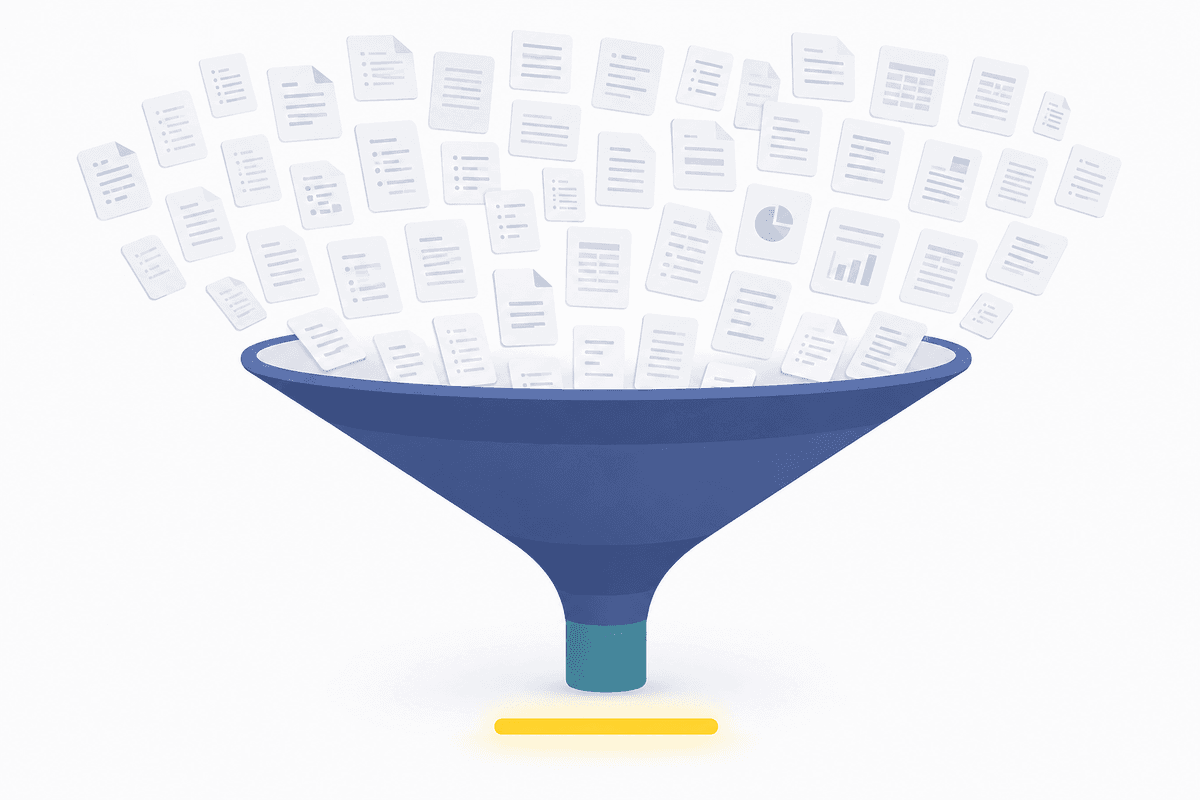
The most common false start in literature review writing is a topic that is too wide. When the scope covers an entire discipline, the core elements — object of study, methods, mechanisms, results, open disputes — can no longer be condensed into one thesis sentence. Once those elements lose their one-sentence shape, the genre slides from systematic review into a long textbook chapter without anyone deciding it should.
"AI in imaging diagnostics" is the classic oversized title. It will end up as a textbook. A workable title states the object, the method or mechanism, the result, and the unresolved controversy. For example:
Diagnostic-consistency gains, hallucination failure boundaries, and the multi-center validation gap of large language models in clinical decision support
One more question before writing: compared with recent literature reviews on the same subject, what will this one explain that they did not? If there is no answer, the title is not focused enough yet.
Prompt A · Narrow the topic
Help me compress the scope of a literature review on [research topic] until it fits a single article.

First, give a one-sentence position: the one core question the whole review keeps returning to.
Then write one paragraph of boundaries: object of study, methods, mechanisms, results, and the unresolved controversy.
Then add three scoping decisions: what this review will include, what it will deliberately leave out, and the new angle it will offer that existing reviews do not.

Add a maturity verdict: mature / still open / exhausted. If the number of comparable reviews in the last 3 years cannot be verified, write "unverified".

Hard rule: if maturity ≠ "still open", do not proceed to the next step.
Step 2: Make the whole search reviewable
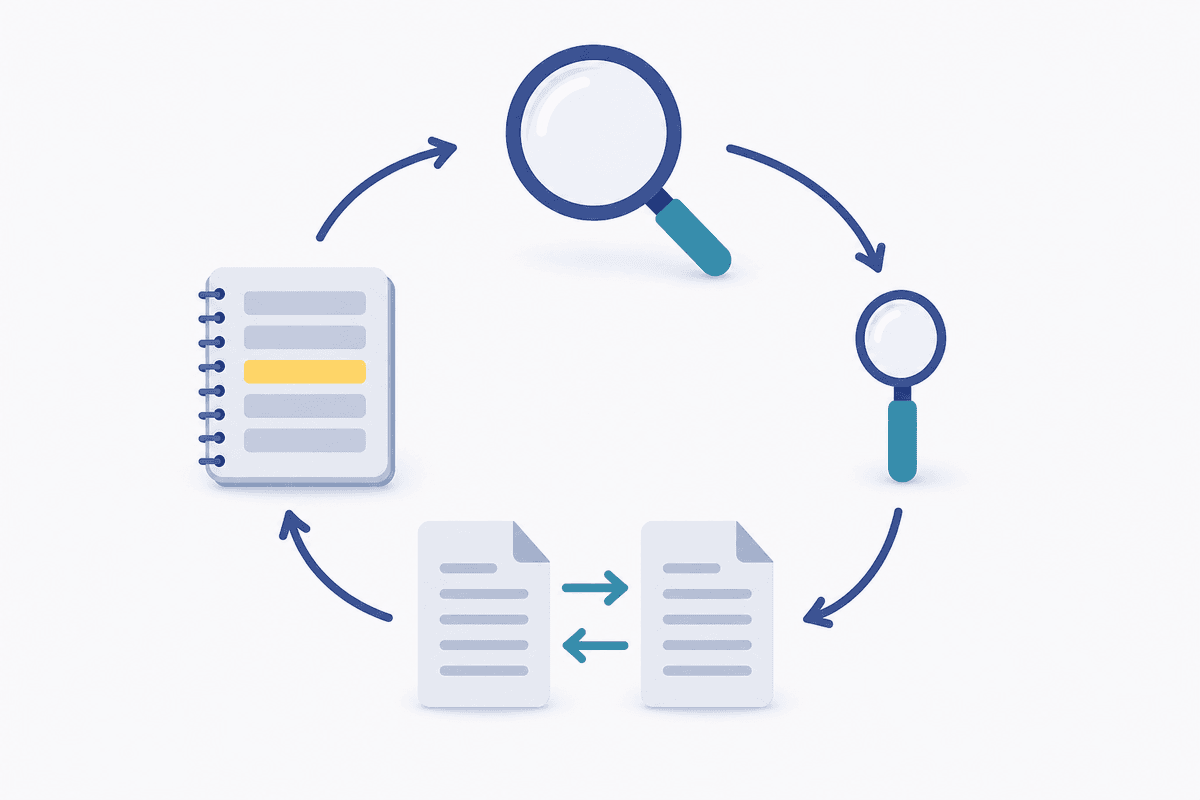
Searching is never a single pass. A literature review goes through rounds: start with broad terms to probe recall, add narrow terms once you see what comes back, run forward and backward citation chasing, then probe again with new vocabulary. Each round waits for the previous one to finish before the direction changes.
Hard thresholds like "there should be N relevant studies in the last three years" are soft references at best. One number does not fit every discipline, and enforcing it will cut off directions that were worth writing about. Prompt B below turns this into a Codex Skill step with a search log you can audit afterwards.
Prompt B · Search plan
Build a traceable search plan around [central question], time window [years].

First, list a "term family": primary keywords, their synonyms, with English and Chinese equivalents.
Then a database list: name / disciplinary coverage / recommended priority P0-P1-P2.
Then, for the databases I can actually access, the corresponding search strings (pubmed / embase / web_of_science / cnki, etc.).
Then two sets of criteria: inclusion and exclusion.
Then a search log schema: date / database / query / hits / screened / included — recorded at the time, never reconstructed afterwards.
Finally, a concrete procedure for forward and backward citation chasing.

Hard rule: never invent a search string; anything that cannot be verified is marked "unverified".
Step 3: Leave an evidence relation for every paper in the review
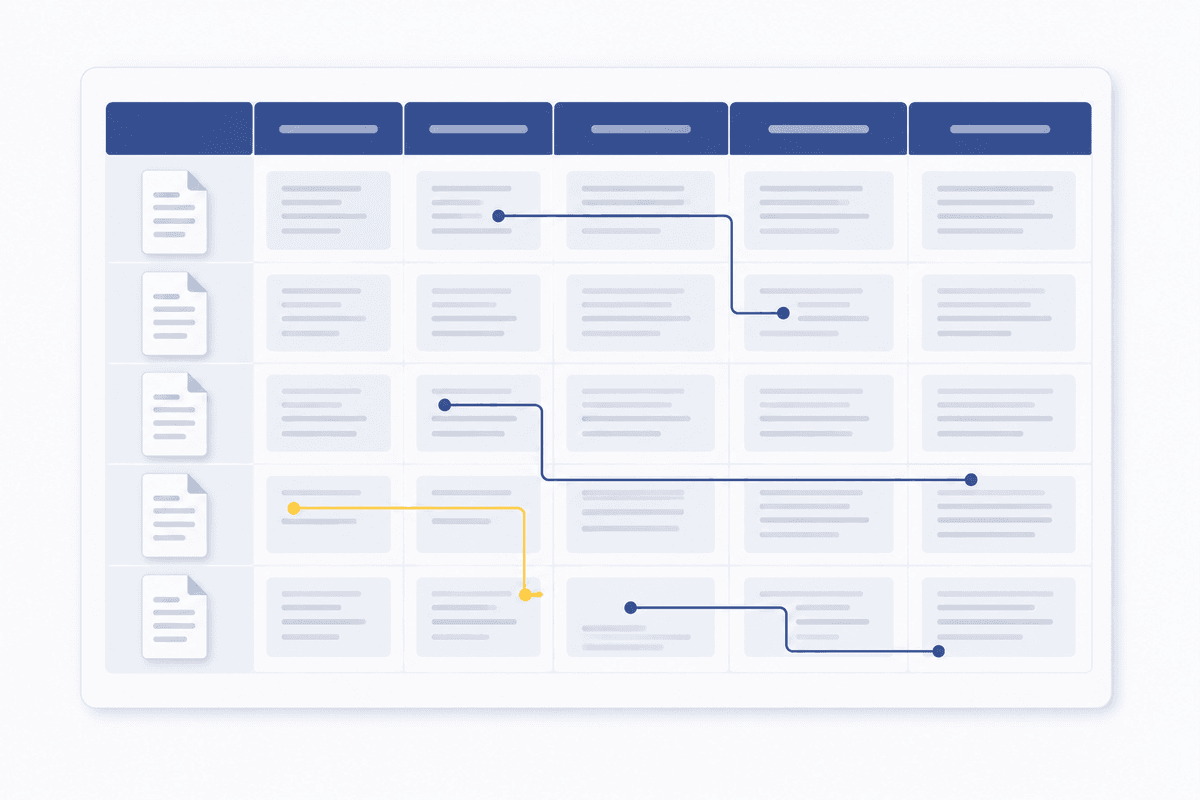
A one-line summary cannot hold up a literature review. Every core paper needs a few structured fields beyond the abstract: object of study, sample size, method, the most relevant finding, evidence strength and limitations, its relation to other studies, and the section of the review where it belongs.
Bibliographic metadata can live in the reference manager. The author's own judgement has to be recorded separately, and the note has to answer a different question from "what did this paper do": which side does it take in the review's argument — does it support the previous paragraph, extend the middle one, or overturn the next one entirely?
Prompt C · Evidence matrix
From the [papers] I provide, build an evidence matrix around [central question]. One row per paper.

Columns for each row:
- title and research question;
- object / sample size (write "unverified" if the paper does not report it) / method;
- the finding most relevant to the central question;
- evidence strength (A strong / B medium / C weak) plus the basis for your rating;
- two main limitations;
- this paper's position relative to the others: supports, extends, conflicts with, or overturns;
- the section of the review it belongs in, and whether it needs a figure or table.

Hard rule: never add conclusions or numbers the authors did not report; any figure that cannot be found in the paper is "unverified".
Step 4: Build the skeleton from themes and disputes, not from a paper carousel
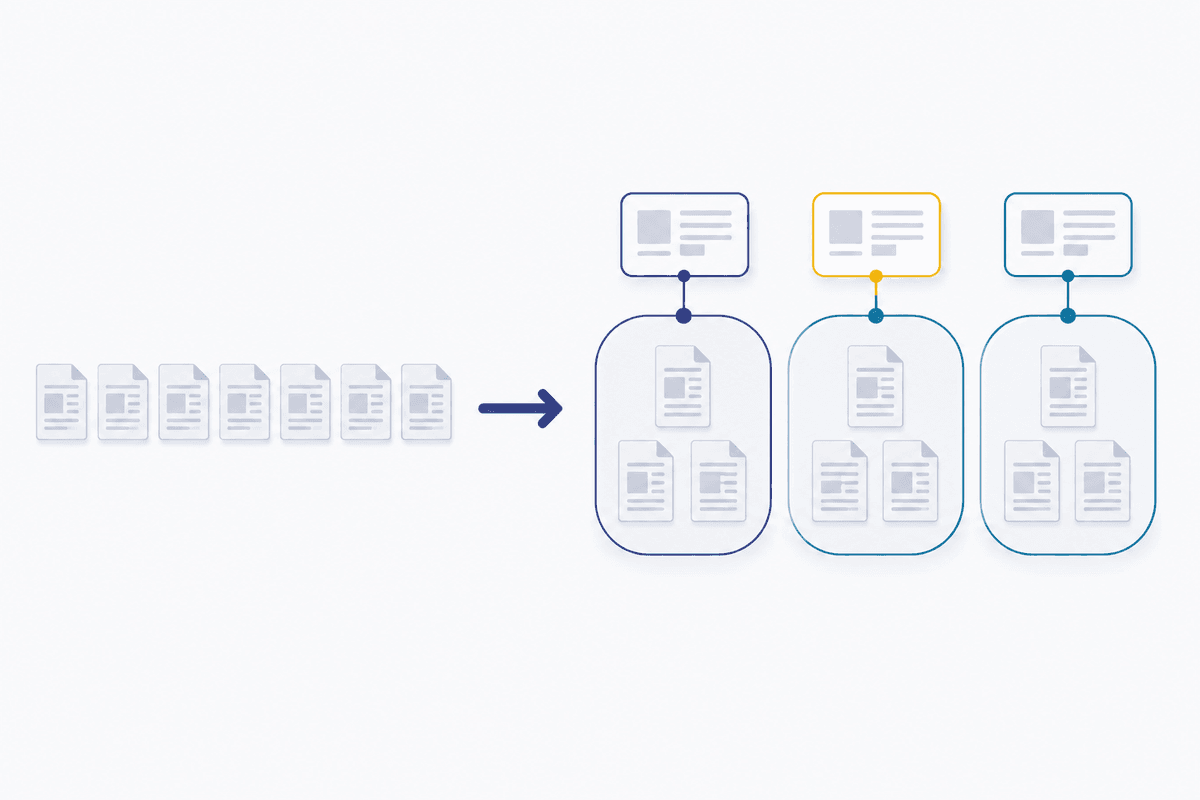
"A found… B found… C further found…" — read one paragraph and it seems informative; read the whole section and the reader still has no stable judgement to hold. The better structure gives every paragraph six fixed slots: the judgement first, then the key evidence, then agreement or conflict, then the possible reasons for the conflict, then the limits and boundaries, and finally the question that remains open.
For the review as a whole, the grouping logic usually comes down to four choices: by mechanism, by method, by application scenario, or by core dispute. All four stand up. Chronological order is the one to avoid, unless time itself is the argument the review is making. Prompt D is the Codex Skill step that does the regrouping.
Prompt D · Thematic synthesis
Fold the evidence matrix into 3–6 thematic modules (grouped by theme or by dispute).

For each module write six things:
- the best-supported judgement at present;
- the papers that hold it up (with strength);
- whether those papers conflict;
- if they do, whether the difference comes from subjects, samples, measurement, method, or study conditions;
- the boundary of the judgement;
- what the judgement still leaves unresolved.

Module names: 5 words or fewer.

Hard rule: exactly 3–6 modules; never turn correlation into causation; unexplained conflicts stay marked "open".
Step 5: Plan the literature review outline and its figures together

If the outline is just three columns — background, methods, applications — the argument density of every section collapses. What each section actually has to hold is the judgement it will make, the specific evidence that supports it, and its exact position in the chain of argument.
Figures are planned at the outline stage, not after. Keep only the kind that compares methods side by side, explains a mechanism, or pulls several research lines into one frame. Anything that can be said in one sentence does not need a figure.
This is also the point where a planned figure has to become a real one, and a Nature-grade review is usually judged on exactly those comparison and mechanism figures. PaperBanana turns the figure description you wrote into the outline — "a three-column comparison of retrieval, fine-tuning and prompting approaches with their failure modes" — into a publication-ready figure, so the figure plan and the draft grow at the same pace.
Prompt E · Outline design
Build a literature review outline around [central question] for [target readers / journal].

For every section give five things:
- the research question this section answers;
- the core claim this section makes (one sentence);
- the literature evidence that supports the claim;
- how it connects to the previous and next section;
- the accompanying figure or table and what it is for.

Hard rule: every section must carry question / claim / evidence / figure_or_table; every evidence entry must trace back to a specific row of the evidence matrix.
Step 6: Run one hard evidence check before the review goes to Nature

Before submission, walk the final draft through nine minimum requirements: scope, coverage, depth of synthesis, density of judgement, balance, novelty, readability, citation-to-claim fit, and currency. Any item that fails sends you back to revise.
The most common problem is conclusions that say more than the evidence does — and that is precisely what reviewers pick on first. Where the evidence does not reach, step the wording down a notch: "current studies suggest", "cannot yet be determined", "requires further validation". Writing a claim that still needs verification as an established fact hands the reviewer a lever. Prompt F, the last Codex Skill step, checks exactly that.
Prompt F · Final audit
Audit a [full literature review] and mark every item as pass / needs revision / insufficient evidence.

Nine checks:
1. Is the scope focused?
2. Is the search multi-source and traceable?
3. Is this synthesis, or a paper-by-paper list?
4. Do the conclusions map to adequate evidence?
5. Are counter-examples, conflicts and limitations presented?
6. Is there a clear new framework or research roadmap?
7. Are terminology, structure and figures easy to read?
8. Does each citation support the specific claim next to it?
9. Is another search round needed before submission?

For each item give the location, the risk, and the fix.

Hard rule: never fabricate literature or conclusions to make the audit pass; when final_verdict is "insufficient evidence", no "borderline submittable" loophole.
Package the Six Moves into One Codex Skill
The six prompts above run on their own, and they also combine into a single skill. Paste the block below into the entry point of $write-critical-literature-review as the startup section, and every move can be dispatched from one place.
Skill master prompt · $write-critical-literature-review
$write-critical-literature-review is one end-to-end workflow.

Invocation: given [research question], [target readers / journal], [review type], [time window], [databases or existing papers], run these seven moves in sequence —

A scope → B search plan → C evidence matrix → D thematic modules → E outline → F figures → G final audit.

Each move proceeds only when verdict = pass; verdict ≠ pass triggers a rollback to the previous move.

Global rule: no invented citations, no invented data, no invented author positions; anything that cannot be verified is marked "unverified".
The rhythm that makes this Codex skill genuinely useful is batching rather than dumping everything on the model at once: let A fix the scope first, use B–C to build the evidence matrix, let D–E raise the themes and the outline, and finish with F as a full audit. Every step can then be accepted or reworked on its own, and a wrong turn stops immediately instead of three sections later.
Where PaperBanana Fits
Six of the seven moves above are about text: scoping, searching, tabulating, synthesising, outlining, auditing. The one that is not — the figure — is the part reviewers look at first, and in a Nature-grade literature review it is where the comparison across methods or the mechanism across studies gets made visible.
That is the part we build for. PaperBanana generates publication-ready academic figures from a text description, and can convert any figure into a fully editable SVG when a reviewer asks for one more label. If you would rather install a maintained workflow than paste prompts, our Paper Skills directory reviews Codex and Claude Code skills for literature reviews and paper writing, with install commands and honest notes on what each one does well.
Sources Behind the Method
- How to write a superb literature review — Nature, career column, 2020
- Ten simple rules for writing a literature review — PLOS Computational Biology, Pautasso, 2013
- The FEBS Journal author guidelines on writing a review article (journal website)
- Literature review guidance — University of Edinburgh, Institute for Academic Development