
From Chatbot to Lab Bench
On June 30, Anthropic shipped Claude Science, an "AI workbench for scientists" now in public beta. TechCrunch's framing of the launch was telling: it bets on workflow, not a new model.
That one sentence captures where AI-for-research actually stands in mid-2026. The models have been good enough for parts of research work for a while. What changed over the past fourteen months is the scaffolding around them: connectors that cite their sources, agent skills for bioinformatics pipelines, funded partnerships with real institutes, and a grant program that pays for your tokens.
We collected the announcements and press coverage, checked the claims against primary sources, and distilled them into this guide — plus what it means in practice if you write papers for a living.
The Timeline at a Glance
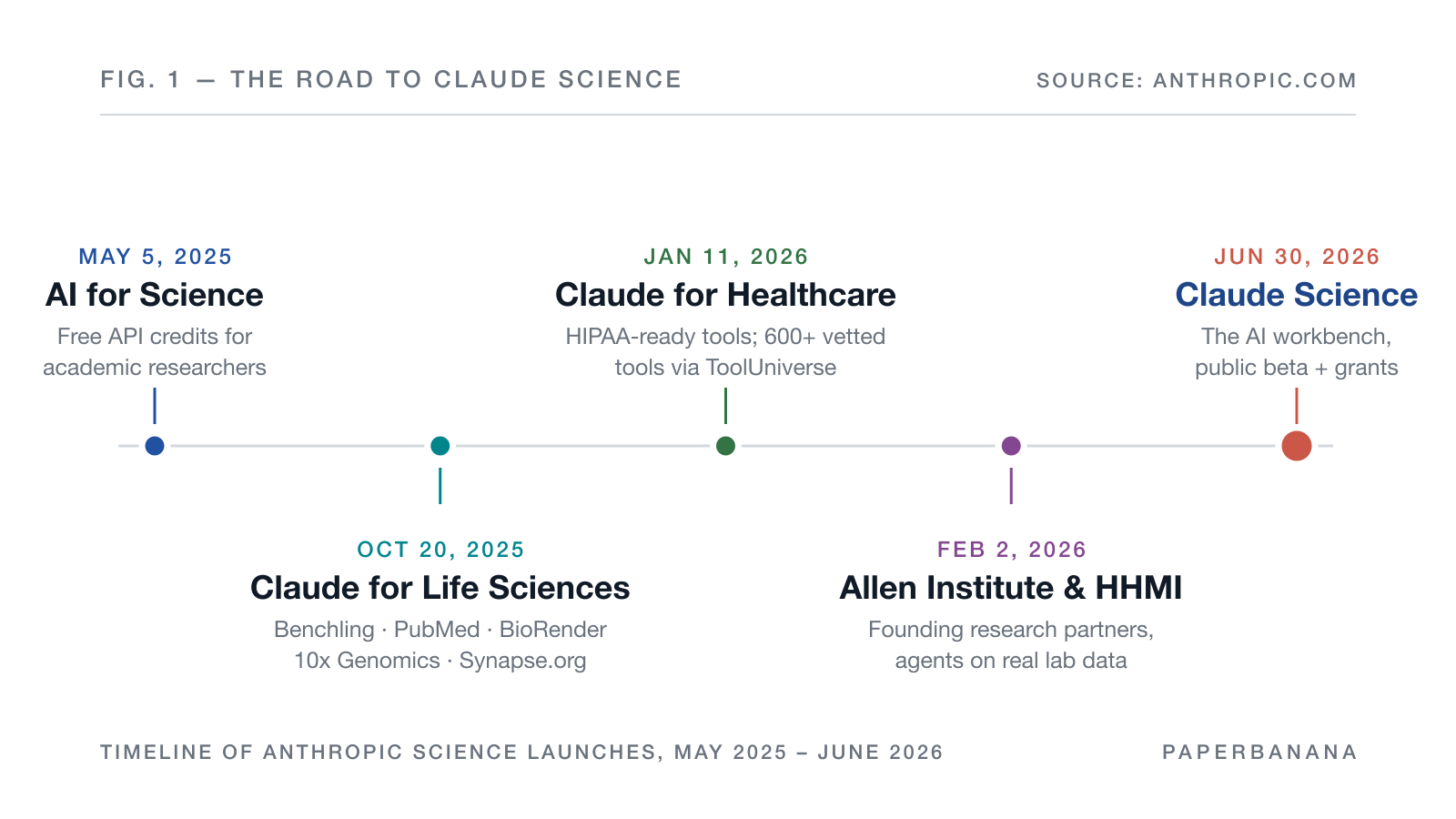
| Date | What launched | Why it matters |
|---|---|---|
| May 5, 2025 | AI for Science program | Free API credits for academic and nonprofit researchers |
| Oct 20, 2025 | Claude for Life Sciences | Connectors to Benchling, PubMed, BioRender, 10x Genomics, Scholar Gateway, Synapse.org |
| Jan 11, 2026 | Claude for Healthcare + expansion | HIPAA-ready tools; ToolUniverse (600+ vetted tools), bioRxiv/medRxiv, Open Targets, ChEMBL; new Agent Skills |
| Feb 2, 2026 | Allen Institute & HHMI partnerships | Founding partners building multi-agent systems on real lab data |
| Jun 30, 2026 | Claude Science | A dedicated research workbench app in public beta — plus a refreshed grant cycle |
Claude Science: A Workbench, Not a Model
The new app is Anthropic's clearest statement yet about what it thinks researchers need: not a smarter chatbot, but an environment where literature search, data analysis, and drafting happen in one place, with full citations and audit trails from first hypothesis to final submission. It ships with preconfigured connections to PubMed, bioRxiv, 10x Genomics Cloud, Benchling, and ClinicalTrials.gov.
Availability, per Anthropic: beta on macOS and Linux, for Pro, Max, Team, and Enterprise plans (Team and Enterprise require an admin to enable it).
The launch case study is worth reading even if you never install the app. Allen Institute neuroscientist Jérôme Lecoq says a single computational literature review used to take his team as long as two years; per Anthropic's launch post he now has about ten of them, many over 100 pages, with citations checked by reviewer agents. MIT Technology Review called Claude Science Anthropic's newest flagship product — a strong signal of where the company is pointing.
The Plumbing Is the Point: Connectors That Cite Their Sources
The October 2025 Claude for Life Sciences launch introduced the piece researchers should care about most: connectors built on the Model Context Protocol (MCP) that link Claude's answers back to the source — the experiment record in Benchling, the paper in PubMed, the dataset in Synapse.org. Benchling's own announcement describes one-click traceability to the underlying scientific data.
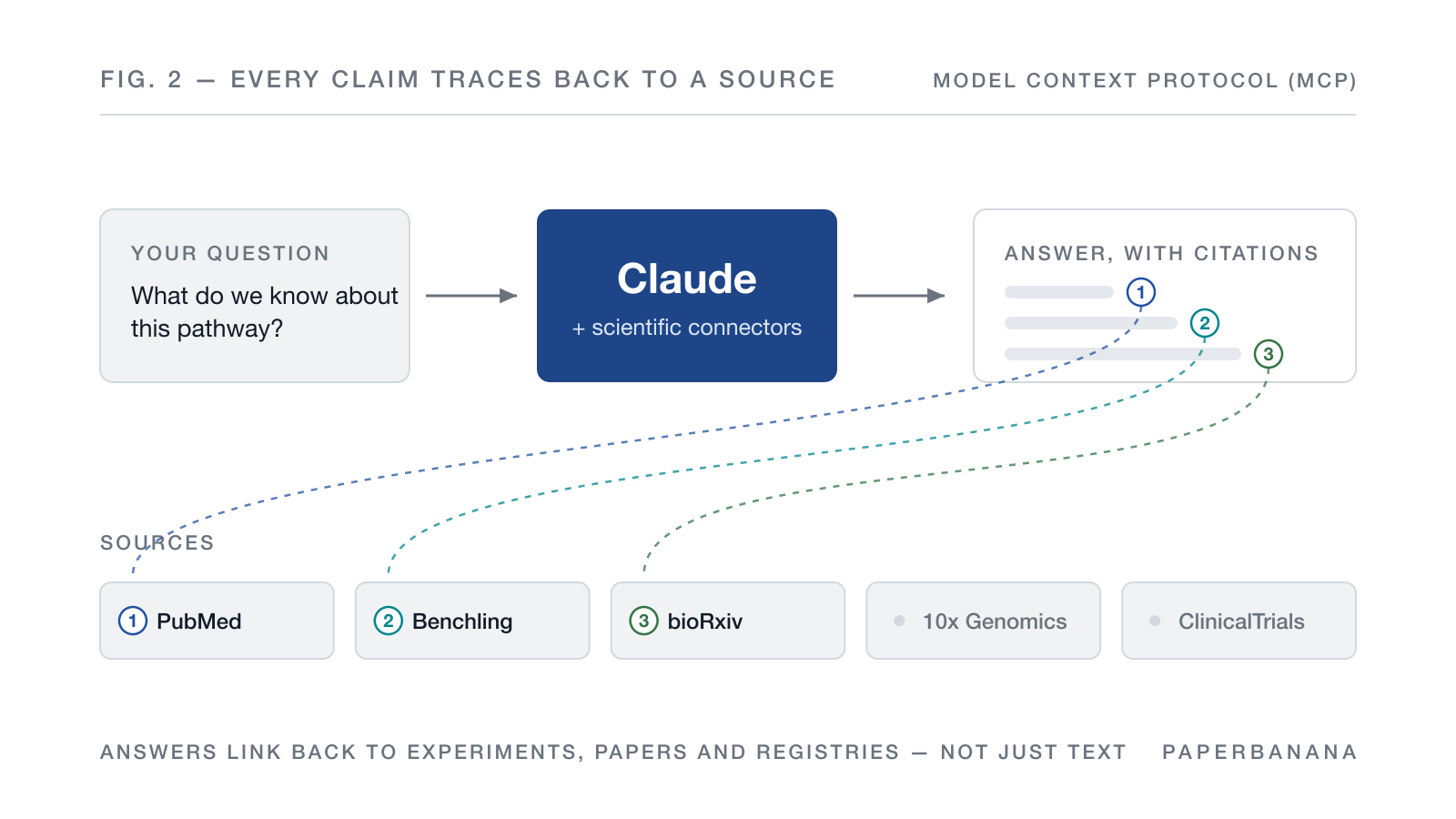
The January 2026 expansion added ClinicalTrials.gov, bioRxiv and medRxiv, Open Targets, ChEMBL, ToolUniverse (600+ vetted scientific tools), and Owkin's pathology agent — plus Agent Skills for converting instrument data to the Allotrope standard, scVI-tools and Nextflow bundles, and drafting clinical trial protocols.
For anyone who has been burned by a hallucinated reference, this is the feature that matters. An AI answer you can trace to a DOI is a research tool; an AI answer you can't is a liability.
Free Credits — and a Deadline in Two Weeks
Anthropic has been quietly funding researcher usage since May 2025:
| Program | What you get | Terms |
|---|---|---|
| AI for Science (standing) | Up to $20,000 in API credits | 6-month period; API-only, standard models; competitive application |
| 2026 Claude Science cycle | Up to 50 projects supported, up to $30,000 in credits, plus up to $2,000 in Modal compute for select projects | Applications close July 15, 2026; awards by July 31; projects run Sep 1 – Dec 1, 2026 |
Both are selective and favor high-impact work, with a bias toward biology and the life sciences. If you have a project that could use serious API volume, the July 15 deadline is the actionable item in this whole article.
The Numbers Coming Out of Industry
All of these are self-reported by the companies involved — treat them as claims with names attached, not audited facts:
- Sanofi: its internal Claude-powered assistant, Concierge, is used by roughly 60,000 employees across R&D, HR, and engineering, according to Chief Digital Officer Emmanuel Frenehard.
- Novo Nordisk: Claude helped cut clinical study report writing times by 90%, according to Digitalization Strategy Director Waheed Jowiya; independent reporting has described drafts going from roughly 15 weeks to minutes.
- Benchmarks: Anthropic reports Claude Sonnet 4.5 scored 0.83 on Protocol QA — a lab-protocol benchmark from FutureHouse's LAB-Bench — against a human expert baseline of 0.79.
- Institutes: the Allen Institute is building multi-agent systems for multi-modal data analysis with Anthropic, and HHMI's collaboration — anchored at Janelia Research Campus under its AI@HHMI initiative — targets specialized agents that plug into lab instruments and analysis pipelines.
Honest Caveats
The same discipline you would apply to any vendor announcement applies here:
- Every headline number above is self-reported. We verified that each statement was really made by the person or page cited — not that the metric survived an independent audit.
- Claude Science is days old. Beta, macOS and Linux only for now, plan-gated, and details will drift. Check the current state before building your workflow on it.
- Agent-checked citations are not you-checked citations. The Next Web raised the obvious worry: tools that draft 100-page reviews at scale could flood an already strained literature. Journals have not settled their policies yet. Verify before you submit — always.
- The credits are competitive and API-only. They do not cover the Claude web app, and the fine print leaves amounts to Anthropic's discretion.
The Part of the Paper That Still Needs You
Notice what every one of these launches is about: reading, retrieving, analyzing, drafting. The figure — the thing reviewers look at first — is still your job.
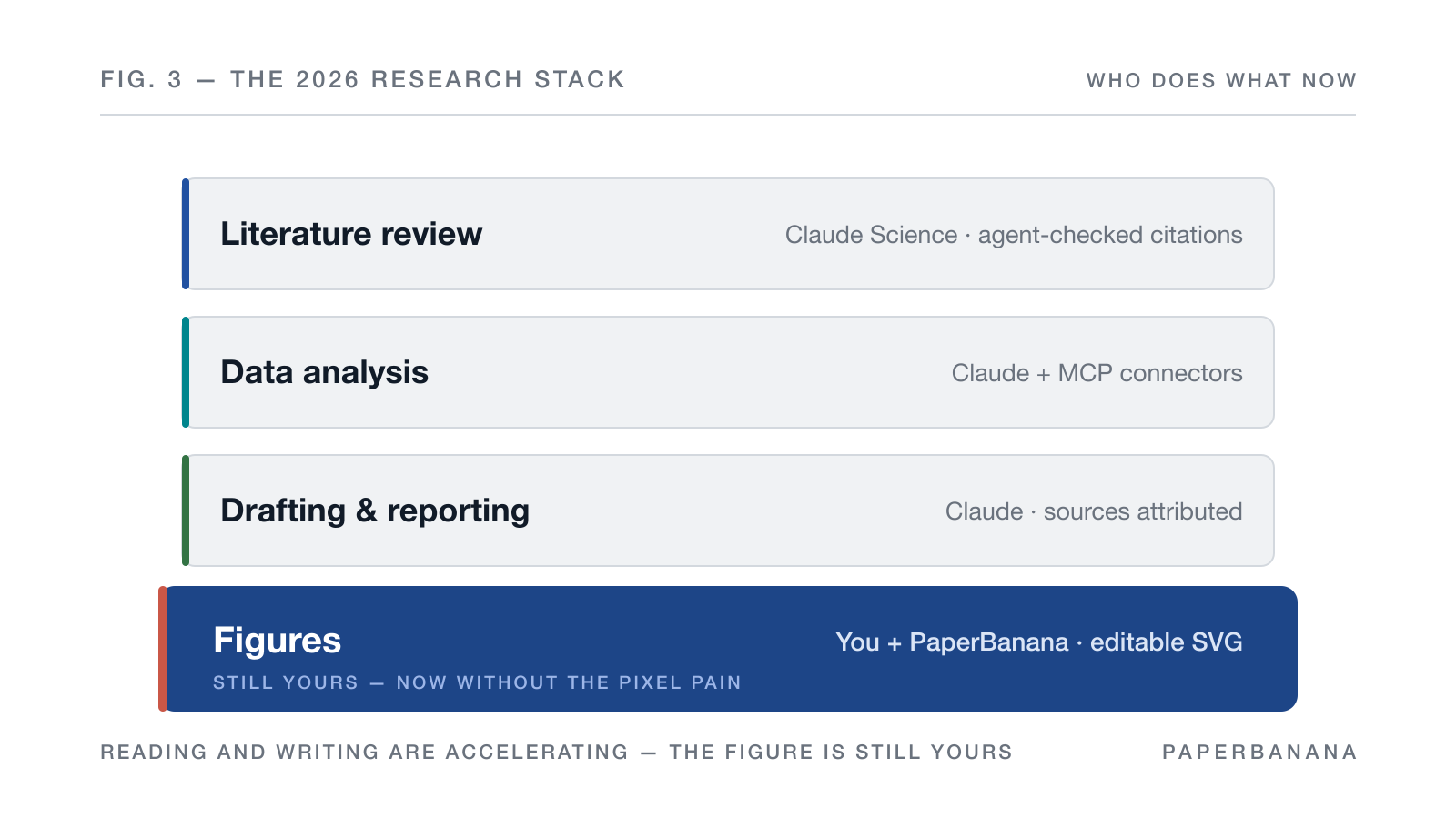
That is the part we build for. PaperBanana generates publication-ready academic figures from a text description, and since last week it can convert any figure into a fully editable SVG — so when the AI-accelerated draft is done, the diagram that goes with it is just as fast to make and just as easy to fix.
Open the generator and see how your next figure fits into the new research stack.
Sources
- Introducing Anthropic's AI for Science program — Anthropic, May 5, 2025
- Anthropic launches a program to support scientific research — TechCrunch, May 5, 2025
- Claude for Life Sciences — Anthropic, Oct 20, 2025
- Benchling partners with Anthropic — Benchling, Oct 20, 2025
- Advancing Claude in healthcare and the life sciences — Anthropic, Jan 11, 2026
- Anthropic partners with Allen Institute and HHMI — Anthropic, Feb 2, 2026
- Claude Science, an AI workbench for scientists — Anthropic, Jun 30, 2026
- Claude Science is Anthropic's newest flagship product — MIT Technology Review, Jun 30, 2026
- Anthropic's Claude Science bets on workflow, not a new model — TechCrunch, Jun 30, 2026
- Customer story: Novo Nordisk — claude.com